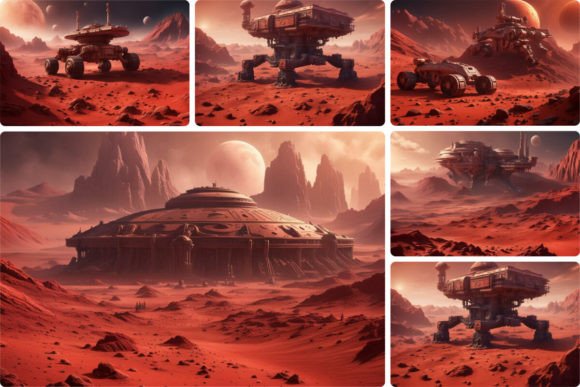
Mars Background Digital Papers: A Versatile Asset for Creative Projects
Whether you are designing a planetary-themed greeting card, crafting a journal cover, or building a cohesive brand identity for a space-related product line, a high-quality Planet Mars Background offers a reliable visual foundation. This collection of six digital papers, each measuring 3000 by 2333 pixels at 300 DPI in JPG format, is engineered to fit seamlessly into both digital and print workflows. Rather than being a decorative afterthought, these backgrounds function as a strategic asset—one that can streamline your creative process, maintain visual consistency, and reduce repetitive groundwork across multiple projects.
Understanding the Asset: What a Mars Background Brings to Your Process
A Planet Mars Background is not simply an image of the red planet. It is a textured, often layered representation of Martian terrain, rust-colored regolith, and subtle atmospheric gradients. The six variations included in this pack allow you to select a tone that matches the mood of your project—whether you need a bold, dusty surface for a poster or a softer, muted backdrop for a phone wallpaper. Each file is optimized with a high pixel density (300 DPI) and a generous resolution, meaning you can scale the paper for large-format posters or use it at full size for small phone cases without losing sharpness.
From a workflow perspective, having a pre-made, professional background eliminates the need to build a planet surface from scratch in software like Photoshop or Affinity Designer. You can drop the JPG directly into your project, adjust its position or color grading, and move on to the next layer of design. This efficiency is especially valuable for entrepreneurs and small business owners who juggle multiple marketing materials, social media graphics, and product mockups.
Where a Mars Background Fits in Your Creative Workflow
The beauty of a versatile asset like this is that it can be introduced at nearly any stage of a project. You might use it before you begin a design, as a mood board element that sets the color palette and overall aesthetic. For example, if you are planning a series of astronomy-themed journal covers, you can place the Planet Mars Background as a base layer, then build your typography and icons on top. The pre-existing texture guides your font choices and color accents—warm browns, deep oranges, and muted golds naturally complement the Martian surface.
During active creation, the background serves as a canvas that reacts to your layering decisions. Because the JPGs are high resolution and 300 DPI, you can crop, scale, and rotate them without degrading the quality. This is particularly useful when you are designing for multiple formats: a landscape poster (3000x2333 px at native size) and a portrait phone case (cropped to ~1125x2436 px). You can extract a section of the Planet Mars Background that works best for your composition, rather than being constrained to a fixed aspect ratio.
After a project is finished, the same digital papers can be reused in follow-up tasks—such as updating a website background, creating a coordinated social media template, or preparing a new batch of greeting cards. This reusability supports consistency across your brand’s visual language. Instead of hunting for a new Martian texture each time, you rely on a trusted set of six papers, which also saves time during client revisions or seasonal campaigns.
Practical Integration with Common Tools and Workflows
Digital papers in JPG format are universally compatible. You can drag them into any design software—Canva, Adobe Illustrator, GIMP, CorelDRAW, or even presentation tools like PowerPoint and Keynote. For print on demand (POD) businesses, the 300 DPI ensures that the Planet Mars Background will render cleanly on invites, mugs, notebooks, or throw pillows. When you upload a design to a platform like Printful or Gelato, the printer interprets the DPI and pixel dimensions to produce a sharp physical product.
One common workflow involves creating a layered composite: start with a Planet Mars Background as the deepest layer, add a subtle black vignette or blurred crater element from a second paper in the pack, then place your main subject—for example, an astronaut silhouette or text quote—on top. Because all papers share a coherent color story and resolution, the blend mode adjustments (multiply, overlay, screen) will behave predictably. You can also use the papers as texture overlays on solid-color backgrounds, which adds depth to minimalistic designs.
Preparation and Organization for Efficiency
Before you begin a project, take a few minutes to organize the downloaded zip file. The six digital papers are named generically (e.g., Paper_01.jpg, Paper_02.jpg), so rename them descriptively: Mars_DustyRed.jpg, Mars_CraterDetail.jpg, Mars_AtmosphericGradient.jpg, and so on. This simple step accelerates retrieval during a busy design session. Store the papers in a dedicated folder within your cloud service (Google Drive, Dropbox) or local asset library (Eagle, Adobe Bridge). Because the files are about 5–10 MB each, they load quickly even on lower-bandwidth connections.
If you work with templates in Canva or InDesign, you can preload these backgrounds as “brand assets” or “stock images.” That way, every new document you create for a space-themed project starts with a consistent visual anchor. For teams, share the folder with collaborators so everyone uses the same Martian palette—reducing the risk of mismatched design elements across a campaign.
Use Cases Across Different Roles and Projects
The audience for this asset is broad, and each role can integrate the Planet Mars Background into their own process differently:
- Graphic designers & freelancers can use the papers as reusable backgrounds for posters, flyers, and social media images. The 3000x2333 px size fits common print and digital formats with minimal cropping.
- Content creators & bloggers can set a Mars paper behind a YouTube thumbnail or blog post header to establish a sci-fi or educational theme. Since the JPGs are flat, you can add grid overlays or text without distraction.
- Small business owners & entrepreneurs can produce consistent product images for Etsy or Amazon: use the same Mars background for phone case mockups, then switch to a different texture for a sticker listing. The six variations prevent visual monotony.
- Educators & publishers can incorporate the papers into lesson materials, worksheets, or children’s activity books related to space exploration. The high resolution ensures clear prints in classroom handouts.
- Hobbyists & journal enthusiasts can print the papers on matte photo paper to paste into bullet journals or use as scrapbooking backgrounds. The 300 DPI guarantees that even close-up, no pixelation appears.
Quality Control and Long-Term Usability
When you receive the zip file containing six JPGs, it is worth doing a quick quality check before integrating them into live projects. Open each file at 100% zoom on a calibrated monitor. Look for consistent noise patterns, proper color bit depth (8-bit is standard for JPG), and no compression artifacts around edges. Since these papers are offered as commercial-use assets, you can safely include them in designs you sell—greeting cards, phone cases, wallpapers, posters, and templates. However, always verify the license terms provided by the seller; typically, digital paper packs are allowed for redistribution only within your own designs, not as standalone files.
For long-term use, maintain backups and consider converting the JPGs to PNG or TIFF if you need transparency or lossless editing. But for most workflow scenarios, the JPG format offers an excellent balance between file size and quality. If you plan to heavily manipulate the background (e.g., extreme contrast adjustments or enlargement beyond the original resolution), the 300 DPI source gives you some headroom. For larger-than-original prints (like a 16x24 poster), you can upscale in Photoshop using preserve details 2.0 or similar AI sharpening, and the texture of the Martian surface will help mask any inevitable softness.
Implementation Tips for Smooth Integration
To get the most out of your Planet Mars Background pack, consider these actionable suggestions:
- Match the lighting of your design elements with the background’s ambient tone. Most Mars papers have a high-key, sunlit look; avoid pairing them with deep blue or cold-toned subjects unless you intend a surreal contrast.
- Use color grading sparingly. The natural rust and ochre hues already provide a strong personality. A subtle curve adjustment (increase contrast slightly, reduce saturation a touch) can prevent the background from overwhelming foreground text.
- Combine multiple papers for more complex backgrounds. Place one paper as a full base, then plop another paper on top with a blend mode like Soft Light or Multiply at 30% opacity. This yields a richer, more dimensional surface.
- Prepare crop templates for common sizes (1080x1920 for phone wallpaper, 1920x1080 for desktop wallpaper, 8.5x11 for print). When you need a Mars background quickly, just drop a JPG into your preset template—no rethinking required.
- Optimize for web use by resizing a copy to 1920px wide at 72 DPI. This keeps load times fast for blog headers or website backgrounds while preserving the visual quality.
Thinking Beyond the First Design
A single purchase of six digital papers is a low-stakes investment, but its value multiplies with reuse. The Planet Mars Background pack is not a one-off graphics purchase; it is a component you can incorporate into a repeatable design system. For example, if you run a monthly subscription box for space enthusiasts, each month you can rotate among the six papers to create fresh packaging inserts, social graphics, and instruction cards. Because the papers share a consistent theme, your brand stays recognizable even as the specific background changes.
Similarly, if you produce educational YouTube videos about the solar system, having a ready-to-use Mars background saves you from recording live footage or building 3D environments. Drop a paper behind your talking head or slide transitions, and you instantly elevate the production value without spending hours on rendering. The same principle applies to online courses, e-books, and even event flyers for astronomy club gatherings.
Finally, remember that these digital papers are only one element in a larger toolkit. Combine them with vector icons, typography, and stock photos of spacecraft to create compelling compositions. The key is to treat the background as a strategic starting point—not a final statement—and to let your own creativity populate the rest of the canvas. With a solid, high-resolution Planet Mars Background in your asset library, you remove one variable from the design equation, freeing you to focus on content, message, and audience connection.
Thank you for shopping with us, and we hope this set of six digital papers becomes a reliable resource in your creative, professional, or personal projects—whether you use them on greeting cards, phone cases, posters, websites, or any other medium that calls for the rugged beauty of the red planet.