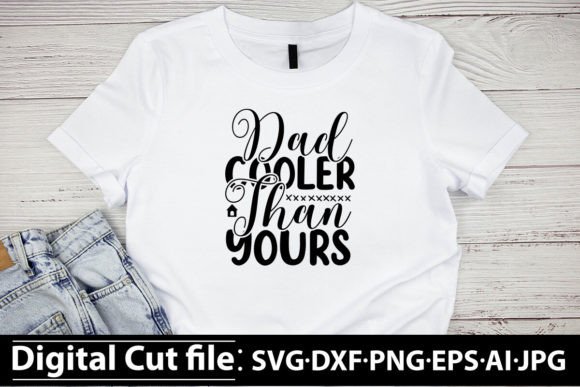
Dad Cooler Than Yours SVG Design: Integrating Digital Assets into Your Creative Workflow
Whether you are a hobbyist looking for the perfect Father's Day gift or a small business owner aiming to expand your product line, the Dad Cooler Than Yours SVG DESIGN offers a versatile starting point. This digital asset package is designed to integrate smoothly into a variety of creative and production workflows. Understanding the specific role each file format plays can significantly improve your project planning, execution speed, and final product quality. This guide walks through how to leverage this SVG design effectively, from initial file organization to finished physical product.
Understanding the Digital Asset Package and Its Practical Value
This is a digital download only, meaning there is no physical inventory to manage. You receive a single .zip file containing six distinct file formats. Each format exists to serve a specific function within a modern design and fabrication workflow. Instead of viewing them as interchangeable options, consider how each one fits into your specific process.
- SVG File (Word By Layer): This is the primary production file for cutting machines. The "Word By Layer" structure is a practical advantage because it pre-organizes the design into individual color layers. This directly reduces setup time in software like Cricut Design Space or Silhouette Studio, allowing you to assign materials and prepare mats faster.
- EPS and AI Files: These are your source and editing files. If your workflow requires modifying the original typography, adjusting color schemes, or rescaling the vector paths for a different product (e.g., a large cooler versus a coffee mug), the EPS and AI formats give you full control over the vector geometry without degrading quality.
- PNG File (300 DPI, Transparent Background): This rasterized format is invaluable for pre-production visualization and marketing. Use it to create realistic product mockups before cutting a single piece of vinyl. The high resolution ensures your product photos look professional, and the transparent background simplifies compositing onto images of coolers, tumblers, or apparel.
- DXF File: Often overlooked, the DXF format is important for maintaining compatibility with older software versions or industrial cutting systems. It provides a clean, geometric representation of the design paths, useful for laser engravers or CNC enthusiasts who may not use standard SVG pipelines.
- JPEG File (Preview Image): A straightforward visual reference for quick previewing without needing specialized software. This is helpful for organizing your digital library or sending a client a fast "look and feel" sample before the project begins.
Before Production: Organizing Your Digital Workspace
Successful project execution starts before you open any cutting software. Once you download the .zip file, take a moment to organize your digital assets for efficient retrieval later. Create a dedicated folder structure in your cloud storage or local drive. For example, Assets > SVGs > Occasions > Father's Day. Consistently naming your folders saves significant time when you return to this design for a future project.
Before importing, verify that your software is updated for compatibility. While modern versions of Cricut Design Space, Adobe Illustrator, and Inkscape handle these formats natively, checking for updates beforehand prevents unexpected errors during the critical production phase. If you plan to edit the design, open the AI or EPS file first. Make your alterations (changing "Dad" to "Grandpa" or adjusting the curve of the text), save a new layered SVG, and then import it into your cutting software. This keeps your modifications linked to a master file, maintaining consistency across multiple projects.
Integrating the Design with Your Tools and Materials
The Dad Cooler Than Yours SVG DESIGN is compatible with Cricut, Silhouette, Inkscape, Adobe Photoshop, and Adobe Illustrator. This broad compatibility allows it to fit into almost any existing toolchain. The key to a smooth integration lies in understanding how your chosen software handles layered SVGs.
When importing the SVG into Cricut Design Space, for instance, the "Word By Layer" structure means each distinct color or piece of text will load as a separate object. You can immediately assign specific materials—such as outdoor permanent vinyl for a cooler or heat transfer vinyl (HTV) for a shirt—without spending time manually ungrouping complex paths. This pre-structuring is a time-saver, especially if you are producing multiple units.
For users working in Adobe Illustrator, the AI file provides access to the exact type layers and path outlines. This is critical if you need to adjust the interlocking of words to ensure structural integrity when the design is cut. You can clean up anchor points or adjust kerning for improved readability on a large surface. Once edited, exporting a new SVG preserves the optimized layer structure for your cutting machine, ensuring the design reads correctly during assembly.
Execution: From Digital File to Assembled Product
The production phase is where the design's structure proves its value. Begin by opening your layered SVG in your cutting software. Check the dimensions against your target product. A 10-inch decal for a Yeti-style cooler requires different scaling than a 4-inch design for a notebook.
Because the design is text-heavy and likely involves fine details like serifs or tight letter spacing, the quality of your weeding process is paramount. Use the provided PNG file as a high-contrast visual weeding guide. After cutting your first layer, place the weeded section on a light box or mat, and overlay the PNG preview on your screen. This allows you to quickly verify that all small interior pieces (like the centers of "A" or "D") have been removed correctly. This simple pre-application check prevents misalignment during the final transfer, reducing material waste.
For multi-color applications, the layered structure dictates your assembly order. Typically, you apply the bottom color first, then layer subsequent pieces over it. The "Word By Layer" file clarifies this sequence, so you are not guessing which word sits on top. This is especially useful for large text designs where precision alignment is visually obvious if done incorrectly.
Quality Control and Long-Term Asset Management
Consistency is critical for both personal projects and commercial production. After assembling your final product, archive the project file (e.g., the .cricut or .studio3 file) alongside the original AI and SVG files. Tag these files with keywords like "fathers day," "cooler decal," and "funny text." Next time you need a gift or a product for Fathers Day, you can retrieve the exact version you used before, ensuring consistent sizing and color for repeat orders.
For small business owners, the standard vector formats (SVG, EPS, AI) allow you to outsource production without losing quality. If demand exceeds your capacity, you can send the AI file to a third-party vinyl cutter and be confident the output will match your original specification. This scalability is built directly into the asset package.
Finally, because these are digital assets, they do not degrade over time. A well-maintained library of SVG designs becomes a commercial asset. You can adapt the Dad Cooler Than Yours design for different clients by simply adjusting the colors in the AI file or tweaking the text in the EPS file. The upfront effort in organizing and understanding these file formats pays off every time you reuse them, making each subsequent project faster and more efficient.
By treating this SVG design as a core component of your digital toolkit, rather than just a one-time cut file, you streamline your preparation, improve your execution, and build a library of resources that support long-term creative and business goals.