Half Blank Half Lined Notebook Journal Guide
If you have ever tried to sketch an idea next to your meeting notes or wanted to write a reflection beside a diagram, you understand the frustration of using a single-purpose notebook. A Half Blank Half Lined Notebook Journal solves that by giving you two functional surfaces in every spread. One side stays free for drawings, graphs, or visual brainstorming, while the other keeps your handwriting aligned and organized. This design is especially useful for those preparing Amazon KDP interiors, where you need ready-to-use files that print correctly with bleed, come in multiple sizes, and offer ruling options that match different workflows.
Whether you are a creator, a professional, an educator, or simply someone who likes flexible note-taking, understanding how this hybrid notebook works can help you decide if it fits your project. Below we break down what you get, why different audiences value different features, and how to choose the right version for your needs.
What You Get with This KDP-Ready Interior
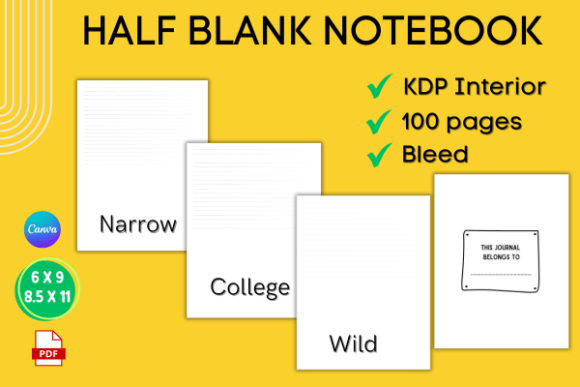
The product being discussed is a digital download – a PDF interior designed for self-publishing on Amazon KDP. It contains 100 pages, each formatted as half blank and half ruled. The layout can be vertical (blank on top and ruled below) or horizontal (blank on one side and ruled on the other), depending on the final design. For this particular interior, the standard arrangement is a left-right split: the left page is blank, and the right page is ruled. But the term “half blank half ruled” generally refers to any notebook where each page or facing pair dedicates equal space to both formats.
- 6 x 9 inches – a popular trade paperback size, portable and comfortable for everyday carry.
- 8.5 x 11 inches – a larger format better suited for desk use, with more writing and drawing area.
- Three ruling versions: Narrow (8mm line spacing), College (7.1mm), and Wide (8.7mm). Each is available for both sizes, giving you six total variations.
- Bleed included – the PDF files are set up with proper bleed (usually 0.125 inches) for Print on Demand.
- Bonus “This Notebook Belongs To Page” – a customizable owner page available in both sizes (PDF and PNG formats).
Because the ruling is the only difference between the versions, your decision comes down to how much line density you prefer. Narrow ruling fits more text per page; college ruling is standard for most journaling; wide ruling suits larger handwriting or younger users.
For Creatives and Designers
If you often sketch user interfaces, mind maps, or product concepts next to written notes, this notebook eliminates the need to switch between a sketchpad and a lined pad. A graphic designer might use the blank side for wireframes and the ruled side for functional requirements. A bullet journalist who enjoys trackers and doodles can keep the visual elements unconstrained while still having lines for to-dos and reflections. The flexibility of the format means you can adapt each page to whatever mood or task arises. For KDP publishers, offering this interior as part of a series targeted at artists or designers can be a smart niche move.
For Professionals and Office Workers
Professionals who attend meetings or manage projects often need to capture both structured notes and spontaneous ideas. A project manager might write meeting minutes on the lined side and sketch workflow charts or timelines on the blank side. A marketer could use the blank area to brainstorm taglines or layout concepts while keeping a running list of action items. The ease of use is a big plus: no flipping between separate pads, no messy freehand lines that interfere with neat writing. For someone evaluating a notebook for daily business use, the quality of the ruling (crisp, consistent spacing) and the paper opacity (not relevant for digital interiors, but important for printing) become priorities. With a digital interior, you control the final printed quality by choosing a reliable printer and paper stock.
For Educators and Students
Teachers often need to prepare handouts that combine diagrams with explanatory text. A half-lined half-blank page is ideal for science worksheets where students draw a cell on one side and label it on the other, or for language learning where they illustrate vocabulary words. Students themselves appreciate the format for note-taking in classes that mix theory with visual examples – like biology, architecture, or engineering. The learning value is enhanced when you can reinforce concepts through drawing without losing the structure of lined writing. For an educator creating a workbook for KDP, this interior could be a timesaver – just add content around the pre-formatted pages. The availability of college ruling (closest to standard notebook paper) makes it suitable for most school-age audiences.
For Entrepreneurs and Small Business Owners
Entrepreneurs juggle many roles: strategist, designer, writer, salesperson. A half-and-half notebook helps them capture a business model on a napkin-like blank space while drafting an email or list on the ruled side. During a brainstorming session, you can draw customer journey maps and jot down corresponding bullet points. The commercial value here is in saving time and keeping all information in one place. If you publish this interior as a “business idea notebook” or “startup journal,” you can target a specific audience looking for a productivity tool that encourages structured creativity. The 8.5 x 11 size gives more room for larger diagrams, while the 6 x 9 size is more portable for meetings at coffee shops.
For Writers and Journalers
Even if you primarily write, there are moments when a blank space helps. A novelist might use the blank side to sketch a character’s appearance or a scene layout, then write narrative on the lined side. A journaler who likes to paste photos or draw can dedicate blank areas to those elements without losing the journaling flow. The long-term usefulness of such a notebook depends on how often you combine visual and textual expression. If your journaling style is mostly linear text, a fully lined notebook might be better. But if you ever feel constrained by lines when adding a doodle or a chart, this hybrid format is worth trying. The three ruling options let you match line spacing to your handwriting size – narrow for compact writing, wide for relaxed notes.
Key Decision Factors for Buyers and Self-Publishers
When evaluating a Half Blank Half Lined Notebook Journal for your own use or for a KDP product, consider these priorities:
- Intended Activity: Do you predominantly write, draw, or both equally? If writing is rare, a dot grid or full blank might be better. If drawing is rare, a full ruled notebook plus a separate sketchbook might suffice. The hybrid is ideal when both happen regularly.
- Ruling Preference: Narrow, college, and wide rule sizes affect readability and handwriting comfort. If you have small handwriting, narrow ruling gives more lines per page. For larger letters or younger hands, wide feels less cramped.
- Portability vs. Space: 6 x 9 fits in many bags and feels like a standard novel; 8.5 x 11 offers almost twice the area per page but requires a larger bag or desk. Your audience will choose based on where they expect to use the notebook.
- Production Quality: As a KDP interior, the PDF comes with bleed set correctly, which saves time and avoids printing errors. The bonus page is a nice touch for personalizing the notebook. If you are the publisher, check the file dimensions match your chosen trim size exactly.
- Cost vs. Value: A digital interior costs a few dollars (or can be part of a larger set). For self-publishers, offering six variations gives customers options without requiring extra design work. For end users, the value is in the convenience of a ready-to-print notebook that matches their style.
Real-World Examples of Usage
- A freelance graphic designer uses a 6 x 9 college-ruled half-and-half notebook during client calls. She sketches logos on the blank pages and writes notes about color preferences on the ruled pages. The small size keeps her desk organized.
- A middle school science teacher prints copies of the 8.5 x 11 wide-ruled version for students to use during a unit on plant cells. The blank side is for drawing the cell; the ruled side is for labeling and writing functions.
- A startup founder prefers the 8.5 x 11 narrow-ruled version for business planning. He uses mind maps on blank pages and action-item lists on ruled pages. The large format lets him see the big picture while keeping details in line.
- A hobbyist bullet journaler uses the 6 x 9 wide-ruled version because she likes large handwriting. She creates habit trackers on blank pages and journals on ruled pages, enjoying the structure without feeling restricted.
Is This Interior Right for You?
If you are a self-publisher looking for a versatile notebook interior that appeals to multiple niches, the Half Blank Half Lined Notebook Journal offers a clear value proposition. It is ready to upload, includes proper bleed, and comes in six configurations that cover most popular preferences. The bonus owner page adds a professional touch. For end users, it serves as a practical tool for anyone who needs to combine writing with drawing, diagramming, or brainstorming. The decision ultimately rests on how you work: if your note-taking regularly includes both text and visuals, this hybrid format will likely become your go-to. If you rarely draw, a traditional lined notebook may be more efficient.
By understanding the different priorities – ruling size, page count, dimensions, and bleed setup – you can select the version that matches your workflow or your target market. Whether you are buying for yourself or preparing a KDP product, the flexibility of half blank half ruled makes it a format worth considering for its ability to adapt to how people think, create, and communicate.